
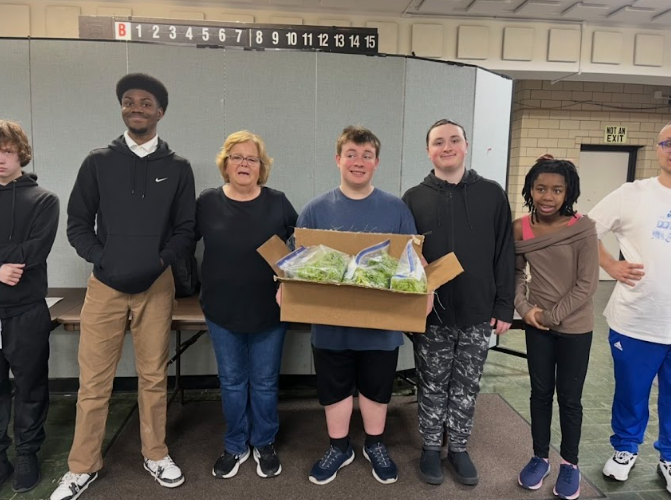
Baldwin-Whitehall isn’t known as a farming community. But students in the F.A.R.M. Highlander Time sessions are growing lettuce without soil – and getting to eat it, as well as donate some to Meals on Wheels.
“It was so fresh,” freshman Anton Dancy said. “The freshest lettuce I’ve ever had.”
F.A.R.M. stands for Foundations in Agriculture Responsibility and Management, and the project offers students the opportunity during Highlander Time to grow plants using hydroponics, a method of growing plants without the use of soil. The growth process takes about four to six weeks in total.
Special education teacher Josh Stahl and biology teacher Kent Radomsky are hosting the Highlander Time sessions.
“We seed them in something called rock wool. We plant the seeds in it, and we have them under a growth light for about a week or two until they start to sprout,” Radomsky said. “Then you take the rockwool, cut it, and stick it into the hydroponic system.”
Their first round of crops consisted of five-star and romaine lettuce, and they ran into no problems in the harvesting process, Radomsky said.
They have completed three rounds of crops, all three of which consisted of lettuce. For the last two rounds, they donated their harvest to Meals on Wheels.
The students come to the Highlander Time sessions daily to complete the tasks that ensure the growth of the seeds.
“The students are checking the pH levels, nutrient levels, making sure the water is cool, and that they are being fed,” Stahl said.
Coincidentally, this is not Baldwin’s first experiment with hydroponic systems and growing lettuce this year.
While Stahl and Radomsky were interested in hosting this activity as a Highlander Time, life skills teacher Katherine Bronco explored the topic with her functional science class at the beginning of the school year.
She started with a few lessons about setting up the hydroponic garden before planting and germinating the plants. She dedicated about 20 minutes several times a week to upkeep the classroom garden. During this time, students discussed maintaining the lettuce as well as checking pH levels and micronutrient counts of the water.
“This (growing with hydroponics) is such an incredible hands-on learning activity in which my students who are non-readers have an opportunity to see science and experiment right before their eyes,” Bronco said.
Stahl agreed that participating in a hydroponics project can benefit all students.
“The hands-on nature of hydroponics supports mental health by reducing stress, increasing focus, and fostering a sense of purpose and success,” Stahl said. “In addition, students are engaging with state-of-the-art agricultural technology, giving them exposure to modern systems used in today’s workforce. Hydroponics is highly accessible, allowing all students to participate regardless of ability.”
At the conclusion of the process in Bronco’s class, each student harvested one plant.
“For the first grow, each student got to take home a lettuce plant and share it with their families. Some chose to eat a bit here while others cooked with it at home,” Bronco said.
Bronco’s class recently concluded the growth of cucumbers and sweet peppers. Students made pickles out of the cucumbers to take home.
Now, they are growing spicy peppers as well as tomatoes. They plan for their final round of the school year to consist of tulips.
Meanwhile, the F.A.R.M. Highlander Time sessions are great for students who wish to pursue a career in agriculture and science, Stahl said. Some students, though, take part just for fun, such as freshman Jennisha Rai.
“I was just looking for a Highlander Time, so I joined it, and I told my friends to join it, and we’ve been coming back ever since,” Rai said.
Hydroponics is an important way to make science real for kids.
“They get to actually see the application of plant structure, function, and they get to see the importance of the roots of the plant, the photosynthesis of the light source,” Radomsky said. “It brings those kinds of things into reality for them.”
Matthew Crutchman, an extension educator from Penn State 4-H, said hydroponic systems provide benefits for everyone, regardless of a student’s career path, he said.
“Some of the benefits are just basic growing practices, like teaching about how different things grow and different mediums you can grow in,” Crutchman said. “A lot of people don’t realize they can grow their own food, and where food comes from and the process it takes to get there.”
It is important to explore alternative ways of growing crops because of issues like lack of water, the decreasing value of soil, and stress on the current food system. Hydroponics systems help people to do just that, Crutchman said.
Some crops are better to grow inside schools than others.
“Lettuce is the easiest. It’s more abundant,” Crutchman said. “If you have a class that’s six to eight weeks, and you want to grow and take something at the end, you look into plants that grow fast, such as lettuce.”
This activity has been funded through the Baldwin-Whitehall Educational Foundation. The grant provided both Stahl and Radomsky’s Highlander Times sessions and Bronco’s functional science class with the necessary funds for purchasing the hydroponics equipment.
Stahl and Radomsky hope to expand this program in the future by incorporating more classes and exploring new approaches.
“Looking down the road, we want to be involving more classes, getting more hydroponic stations – some homemade, some from companies that already have them built – and incorporating them,” Stahl said.









ANTON DANCY • Apr 21, 2026 at 1:34 pm
I loved it