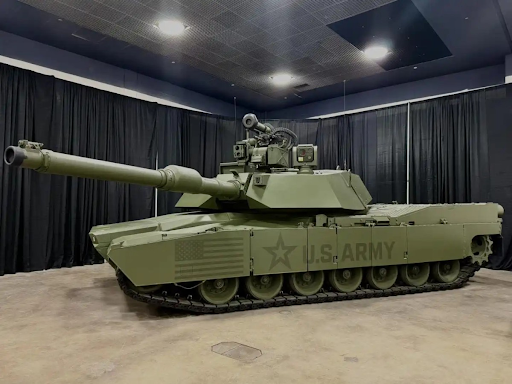
The Army unveiled its newest prototype variant of the M1 Abrams main battle tank, the M1E3.
This new tank is the eighth version of the M1 Abrams and is set to be a major upgrade.
The new design “represents a bold step forward in modern vehicle design,” Michelle Link, deputy executive of the program, said in an Army article on the tank.
The most notable difference many military enthusiasts will notice is the addition of a remote-controlled Javelin anti-tank missile launcher. This missile launcher has become well known since the advent of the Russian-Ukraine War for its top attack abilities and for having destroyed many advanced Russian main battle tanks. The Javelin will provide greater range for the M1E3, beyond the reach of its main cannon.
The crew of the new tank will be reduced from four to three members, with an autoloader replacing the loader. Autoloaders present an increased logistical and technical burden for the crew as well as cutting the manpower present, which has made the Army hesitant to deploy one in a frontline vehicle. The addition of an autoloader is a major departure from previous M1 Abrams designs.
There will also be integration of AI systems in the new tank. The goal is to provide increased lethality and situational awareness for the crew members of the tank. These AI systems can provide better target recognition for the gunner and driving assistance for the driver.
The M1E3 will also be using a new hybrid electric engine for its design, another major departure from the previous turbine engines the M1 Abrams was largely known for. This will decrease the noise signature of the M1E3 significantly compared to the diesel engines used by the Russian T-90M and prototype T-14 Armata.
The reduction of weight is an important detail of the new M1E3. For years the Army has been struggling to reduce the M1 Abrams’ weight. Its predecessor, which weighs 71 tons, struggles to cross many bridges and is a logistical headache. With the M1E3 reportedly weighing 60 tons, it will likely reduce the struggles of previous designs and will lead to increased mobility for the design.
It is expected that there will be four prototypes delivered by General Dynamics throughout 2026 that will be tested for adoption.