Politics is arguably the most divisive topic for discussion in society. For junior Lara Al Imam, the topic can even cause tension between her and her family members.
“After the election, I talked with my cousin, and it felt really weird when I disagreed with her on everything,” Imam said. “Now, we just avoid talking about it because we don’t want to start an argument.”
Sophomore Christian Jones has been in a relationship that was impacted by differing political views.
“She was a little out there with her opinions, and I’m not out there with my political views at all, so watching her post things that I disagree with didn’t sit with me too well,” Jones said. “While it wasn’t the main reason why I broke it off, it was definitely a factor.”
For sophomore Ethan Ellis, dealing with political tension sometimes means stopping the conversation.
“I’ve had people only talking about their opinions … and it got to such an extreme that I had to fully remove myself from the conversation,” Ellis said.
According to an article in The Harvard Gazette, Democrats and Republicans have been segregating themselves based on their political beliefs, with some neighborhoods gaining more conservatives while different ones gained more liberals. In high school, today’s charged political climate can have a similar effect on friendships.
Sociology professor Nick Rogers of the University of Pittsburgh explains that there is evidence that adolescents are prone to developing friendships based on political identity.
“An Australian survey from last year found that teenagers were over twice as likely as middle-aged adults to say that they avoid friendships with people of different political views,” Rogers said.
He also cited another study from the National Library of Medicine that found that rural students, at an average age of 12.5, tended to stay friends with like-minded people. This was “particularly true of kids with conservative values like patriotism or dislike for immigrants,” he said.
Despite the tendency most have to want to speak with like-minded people, political encounters with those who disagree are almost inevitable in the current political climate.
Jones had another rocky friendship in middle school, where the problem was not his political opinions, but rather the lack of a formed opinion.
“Back in middle school, I was not politically informed at all. I didn’t have any opinions – I didn’t know what the world was like around me,” Jones said. “There was this person who solely based our friendship off of what my political views were, and they got really aggressive with me when I told them I didn’t have any.”
Jones said because he wasn’t informed, that student claimed that he was “against me,” and because of that, they could no longer be friends.
But not every student is so focused on politics. Junior Mayen Achuek thinks that since politics is such a sensitive topic, some students care a lot about it, while others don’t want to think about it at all.
“I feel like it’s 50-50. Some high schoolers care, but some don’t.” Achuek said.
Achuek noted that strong opinions do not always lead to open conversations in school settings, where tension can easily rise. Many students avoid discussing politics to prevent arguments and maintain peace with their peers. Because of this, political conversations often stay limited or only happen in certain situations.
“Most people keep it to themselves to avoid arguments with others,” Achuek said.
Al Imam feels similarly in regards to people with strong opinions.
“From what I’ve seen, people who actually have strong opinions either keep them private or only talk about them with their close friends,” Al Imam said.
Conversely, Ellis thinks that although different viewpoints can bring tension between teens, the effects of their differing views are not as pronounced as with adults.
“I’ll see people who have extremely different political views mingle and talk with each other,” Ellis said.
The reason for this, he believes, is that politics are inherently not as big in teens’ lives as adults, because of their inability to vote.
“Teenagers’ political views won’t actually influence change, as adults would. They don’t have the right to vote or anything,” Ellis said.
But sophomore Isabelle Stech disagreed, saying that politics can be just as important for teens as adults – and can have a similar effect on friendships.
“We live in a world where race, sexuality, and other things like that are political. So if they don’t support who you are, it’s hard to be friends,” Stech said. “When people’s identities become political, it makes it so you’re almost forced to care about their ideologies.”
An article from the University of Minnesota explains how in recent years, politics have become “moralized” — people have begun to see someone’s political identity as an indicator of their character, rather than a disagreement over governmental policy.
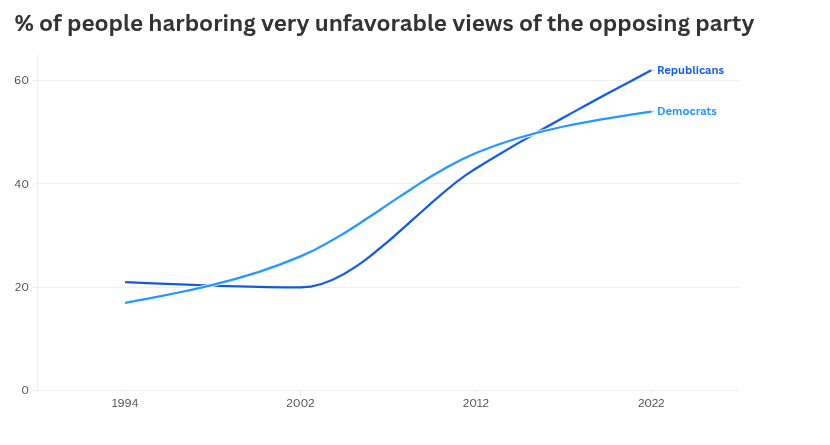
“The moralization of politics is a relatively recent thing,” Rogers said. Although past generations would still disagree, “sweeping moral judgments” were not made about people on the other side.
“Ramping up, I’d say, in the 1990s was the idea that people we disagree with about government are actually bad people, and compromising with them means that we are betraying our values,” Rogers said.
Political viewpoints can certainly still cause tension between friends, or even with completely unknown peers around them.
“Sometimes my view of someone I don’t know can be influenced by their political opinions, even if I try not to judge,” Al Imam said.
Social studies teacher Kathleen Temme feels that politics are naturally a part of current teenage friendships.
“Friendships change a lot,” Temme said. “So politics can be one of the reasons that friendship changes. I feel like today, politics and relationships are pretty intertwined – more so than they ever have been.”
This effect is also true for adults. Ben Sheehan, 41, the author of What Does the Constitution Actually Say? and host of the show Civics Made Easy on PBS, is mostly friends with people who share his left-leaning mindset. But he has had tension within his extended family and in-laws due to his political presence online.
“My wife’s family is largely conservative Republicans. I like finding common ground with them, but I definitely don’t think they like the things I post,” Sheehan said.
Sheehan started posting online after the 2016 election. Since then, he has been posting to try to make people more politically aware and civically engaged. Within his friends, even if they disagree politically, he enjoys talking with them.
“I try to engage with differing opinions from a place of trust and friendship,” Sheehan said.
Although he actively discusses and posts politics, Sheehan thinks the political climate has changed since he was in school. Being in high school in 2001, he remembers “everyone coming together, regardless of party,” after the tragedy of 9/11. But he said this sort of unification “hasn’t happened since, really.”
But the length of a friendship can change the effect that differing viewpoints would have, Al Imam said. She said the longer people are friends with one another, the “more likely people are to stay friends despite political differences.”
Ellis agreed that familiarity with a person may change how their friends view their political views, and that empathy is more likely toward someone familiar.
“If you know somebody for a long time, you might try to ask why they think that, and question them instead of completely stopping the conversation,” Ellis said.
Sheehan thinks that political opinions should not deter a true friendship. In fact, being friends with someone strengthens his chances of discussing politics.
“There’s a responsibility there,” he said, referring to the trust and open communication that a friendship brings. “A foundation of friendship is an incredible gift to start with when it comes to political conversations.”
Social media, though, can have a huge influence on politics.
“A lot of people don’t care about politics before they gain access to social media. It’s also a lot easier to fall into different world views when you get instant content on social media based on other things you watched,” Stech said.
Temme sees students relying more on social media for their political input than on actual news sources.
“They’re really not getting their news from legacy media. … They’re getting it from things like TikTok and other social media,” Temme said.
Temme believes that the social media algorithms are unhealthy for developing political views.
“Depending on what you stop and watch for 30 seconds, you’re just going to keep getting fed that on YouTube, TikTok, Instagram – all that stuff. So it’s had a huge impact on feeding kids information that reinforces their thinking. It doesn’t challenge them at all, and that can be dangerous to their politics and how their politics are developing as teenagers,” she said.
Rogers, the Pitt professor, agrees that social media negatively fuels ideological division in teenagers.
“They take what starts out as a small curiosity or slight preference, and then start feeding us more and more content that pushes us further in that direction,” Rogers said. “That can be pretty innocent if we’re talking about fashion or sports, but it can be really dangerous if we’re talking about important current events.”
No matter where the information is derived from, Temme believes that in-person discussions should be valued higher than the prevalent virtual discourse.
“The most important part of all this is that those discussions have to be happening face-to-face – behind a computer screen is not okay,” Temme said.
Rogers also sees internet debate as unhealthy, and notes that the online environment sets unrealistic negative expectations for discussions at college.
“When people talk about controversial issues face-to-face, there tends to be a lot of mutual respect and openness to learning something new. To a great degree, social media gives us a very distorted image of how political dialogue usually goes,” Rogers said. “It’s easy to call names and be mean when you can hide behind an avatar and a screenname. We’d have healthier debates if we talked about politics in person instead of online.”
He believes that the distortion created with online politics is a problem that only grows as virtual discussion increases.
“More and more of our socializing is virtual, and less and less of it is in the real world, with people we have to look in the eye and run into later at the grocery store,” Rogers said.
While a lot of students are more exposed to virtual than in-person discussion, there are certain spaces and clubs where political discussion is promoted, and the discussion of controversial viewpoints is encouraged. Specifically, Ellis finds the Debate Club to be a great place for discussing different topics.
“(Clubs can) give views of different ways of thought, especially with the Debate Club. Sometimes you’ll be put into somebody else’s shoes and try to debate for that point, even if it’s not what you align with. You have to think: If I were in that position, what would I do?”
Students in the Debate Club are often interested in political topics and controversial ideas. Achuek believes that students who are informed about politics are often more engaged and more willing to think deeply about the issues.
“Those who know about politics are typically really passionate about their views,” Achuek said.
But in other clubs and on high school sports teams, where debate is not a main focus, political opinions often get sidelined. As a soccer player, Achuek notes that in a team environment, the number one priority is the game at hand, and all differences are put aside when focusing on that shared goal.
“There are all sorts of people on the team, and we don’t view our differences as anything bad. We just focus on the game,” Achuek said.
Despite disagreements, Achuek believes political beliefs should not define how people are treated.
“I view people on the way they act, not their political beliefs,” Achuek said.
Jones agrees.
“I think a lot about how concerning it is – how people can solely base each other off of their views instead of the kind of person they are,” Jones said. “I know in many relationships and friendships I’ve had, even though we have different views, we can still appreciate each other and be close.”